From Old Towne's historic bungalows to the hillside homes of Orange Park Acres, inland heat pushes local Ipe decking to gray ahead of schedule.
The City of Orange spans everything from the dense, historic grid around the Old Towne Orange Plaza to the sprawling hillside lots of Orange Park Acres, and Ipe decking shows up in both settings for very different reasons. In Old Towne, small backyard decks attached to century-old homes see intense afternoon sun with little tree cover left after decades of urban infill; in Orange Park Acres, larger equestrian properties feature expansive decks fully exposed on open hillsides. My Teak Pro restores both, tailoring the process to the deck’s age and exposure.
Homes within the Old Towne Orange Historic District are often subject to design review for exterior changes, so restoring existing Ipe decking rather than replacing it typically keeps a property’s original materials intact and consistent with district guidelines.
We’re the same veteran-owned crew behind Orange teak restoration and outdoor furniture refinishing. Browse recent projects in our project gallery or request a free estimate for your Orange Ipe deck.
Two Orange decks the same age can be in very different shape. These are the factors that account for most of the difference.
The dominant variable inland. Cover changes the schedule more than any product does.
Chlorine and constant wetting shorten the interval on the surround specifically.
Inland dust acts as an abrasive underfoot. Regular sweeping genuinely extends finish life.
Grease and heat damage are localised and worth protecting with a mat.
Shade helps, but tannin-heavy leaf litter left to sit will stain Ipe within days.
Orange sits fully inland, away from any coastal marine layer, and its summer temperatures regularly run well above nearby beach cities. Combined with seasonal Santa Ana winds moving through the surrounding hills, this dry heat pulls moisture and natural oils out of Ipe boards quickly, often turning a rich brown deck silvery gray within the first year if it isn’t maintained.
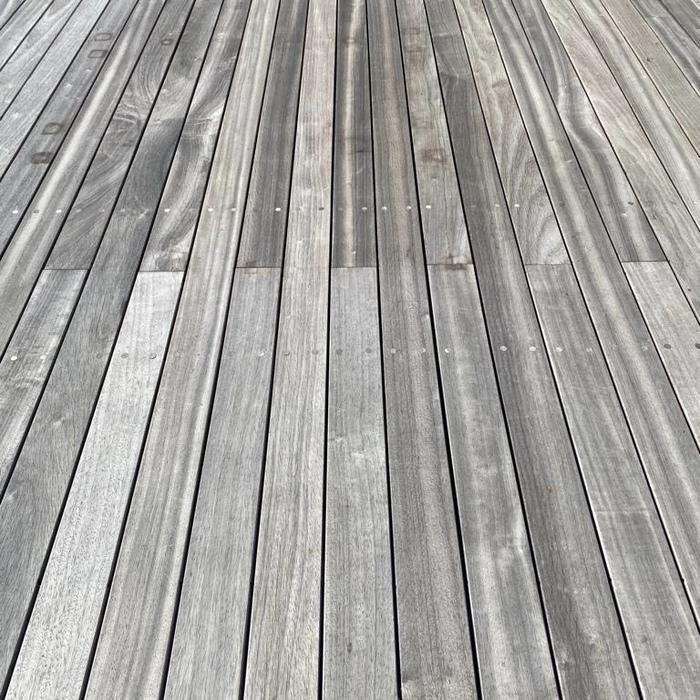
The craft is the same across all of them; access and detailing are what change the day.
Machine work, straightforward, and where most of the square footage sits.
Hand work, safety-critical, and the highest-wear element on any deck.
Vertical, highly visible, and usually more weathered at the bottom than the top.
Constant hand contact, so the finish choice here is about feel as much as looks.
Permanently damp and slip-critical. Product selection is driven by traction, not colour.
Ipe is dense enough that finish failure is almost always a preparation story. We find out what was on it before and why it let go.
Mildew, algae and the black spotting under planters are living, not cosmetic. They get treated before any abrasive touches the wood.
Ipe’s tight pores close up under weathering. Correct grit sequencing opens them just enough to accept oil without leaving scratch marks.
Brightener resets the pH and pulls the iron staining out from around screws so the whole deck reads one color, not a patchwork.
Penetrating oil chosen for your exposure, applied in thin coats. Ipe takes far less product than pine — over-applying is the classic mistake.
We record the exact product and grit sequence used, so the next maintenance coat matches rather than fights what is already there.
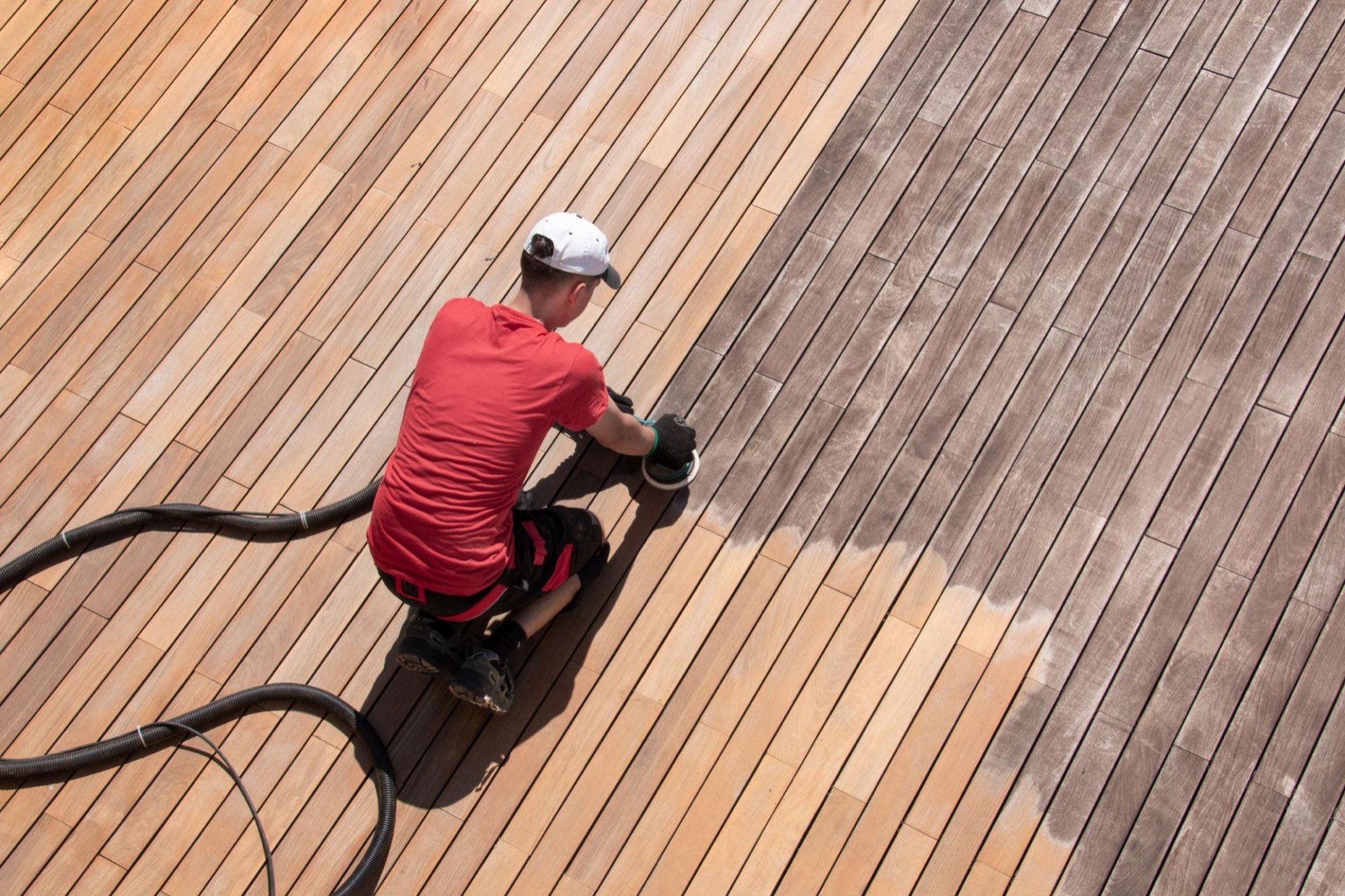
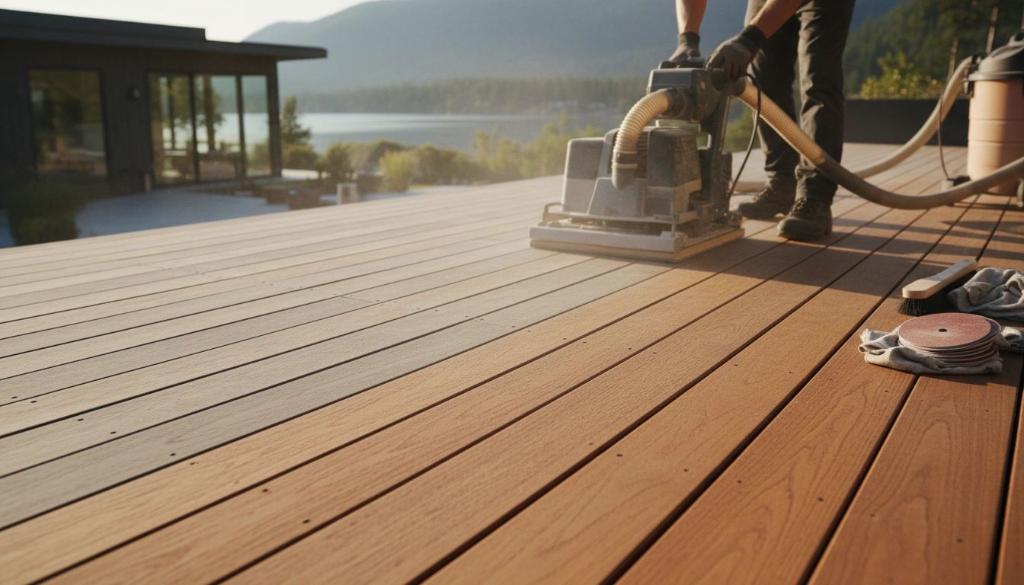
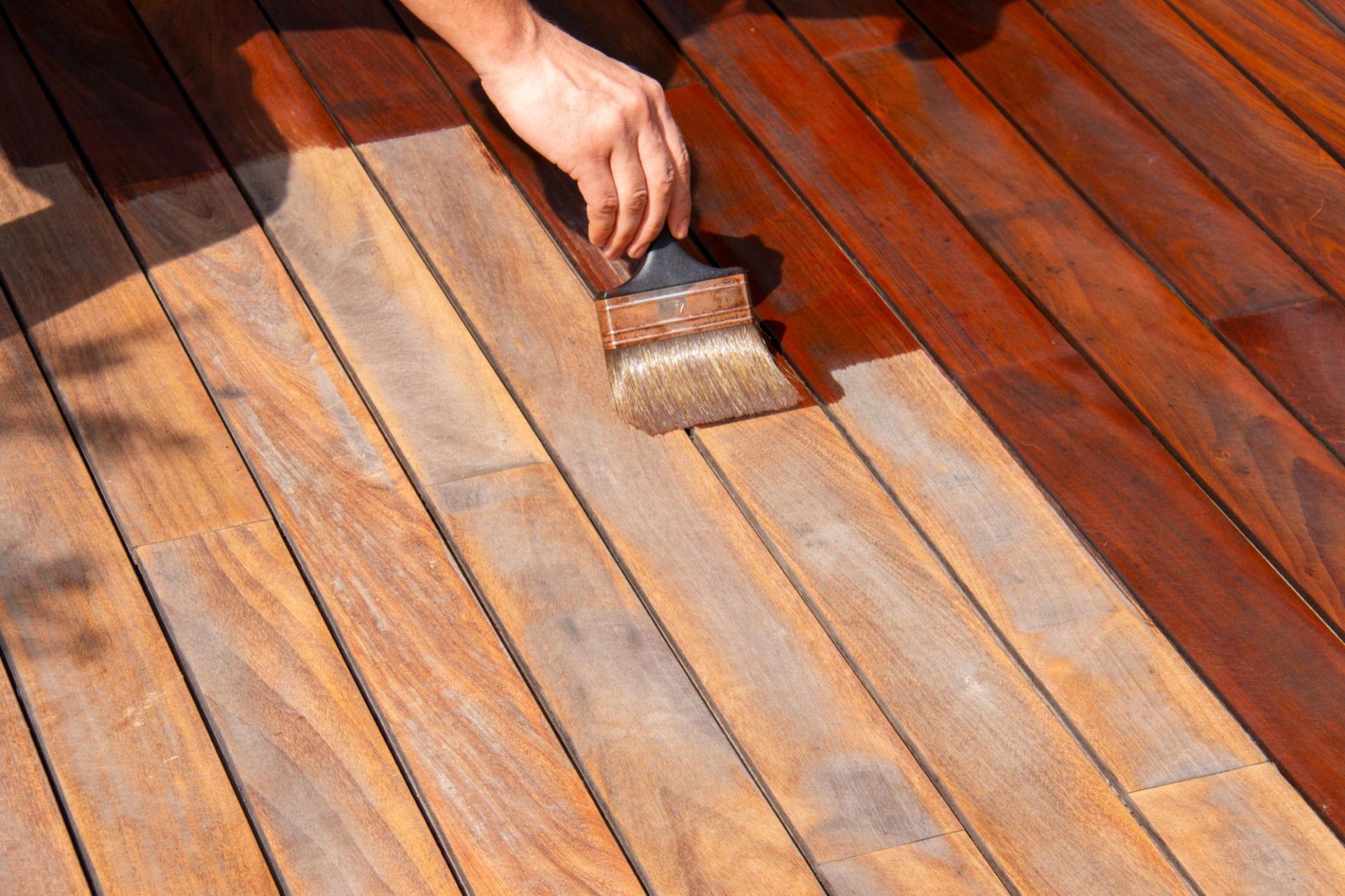
Ipe is not one colour. Depending on the log it can run from a warm reddish brown through chocolate to a distinctly olive-green cast, and a single deck usually has all of it.
Sanding reveals whatever is there — we cannot add colour that the boards do not have, and we will not use a stain to fake uniformity that would then peel. Brightening evens the tone as far as chemistry honestly allows.
Oil deepens what is revealed by roughly one shade and brings the figure up. The first week after finishing is the darkest the deck will look; it settles slightly as the oil cures.
The number on the estimate is the number on the invoice unless you change the scope. No day-rate creep.
The people who quote the job are the people who sand it. Nothing gets handed to a subcontractor mid-week.
If a deck is past finishing we will tell you, in writing, rather than sell you a coat of oil that fails in a season.
Dust containment, contained wash water, tidy staging and no early-morning machine noise.
You are told exactly what goes on your wood and why, and you keep the spec for future maintenance.
Maintenance reminders on your schedule, not sales calls. Most of our work is repeat clients.
A look at recent Ipe refinishing projects — every deck hand-sanded and hand-oiled by our master craftsmen. See more on our full project gallery.


Yes — bayfront decks deal more with humidity and tidal splash, while oceanfront decks face stronger direct salt spray and wind, so we adjust the restoration and maintenance schedule accordingly.
The hillside location gets no coastal marine layer protection and experiences stronger Santa Ana wind exposure, both of which dry out Ipe’s oils faster than coastal climates.
Yes, tighter Old Towne lots often have reflected heat pockets from nearby structures, while hillside decks face open, unshaded sun, so we adjust our schedule and process for each.
Trail dust can settle into open wood grain and accelerate surface wear, so we recommend more frequent rinsing for decks near riding areas.
Yes, we regularly assess older decking for prior coatings or repairs before sanding, ensuring the restoration process suits the deck’s age and condition.
Almost never. Black spotting on Ipe is usually mildew or tannin reacting under planters and metal fixings. It comes out with the right cleaner and brightener, and the wood underneath is sound.
A penetrating hardwood oil selected for the exposure — a higher UV package for unshaded and ocean-facing decks, a softer natural oil for sheltered courtyards. Ipe is too dense for film-forming coatings, which peel.
Significantly. A recoat on a sound surface is a fraction of the cost of a full restoration, because the expensive part of the job is always the abrasion, not the oil.
Often. Cupping is a moisture imbalance between the top and underside. We correct ventilation where we can, re-fix or flip the worst boards, and sand the surface flat as part of the refinish.
Browse all restoration and maintenance guides
Spring and early autumn book out first. A short call now usually means a better slot.
We respond within 1 business day. No spam, ever.
Furniture, decking and brightwork restoration for Orange homes.
Teak Restoration nearby